
How to Use a QR Code for SMS to Drive Faster Customer Response
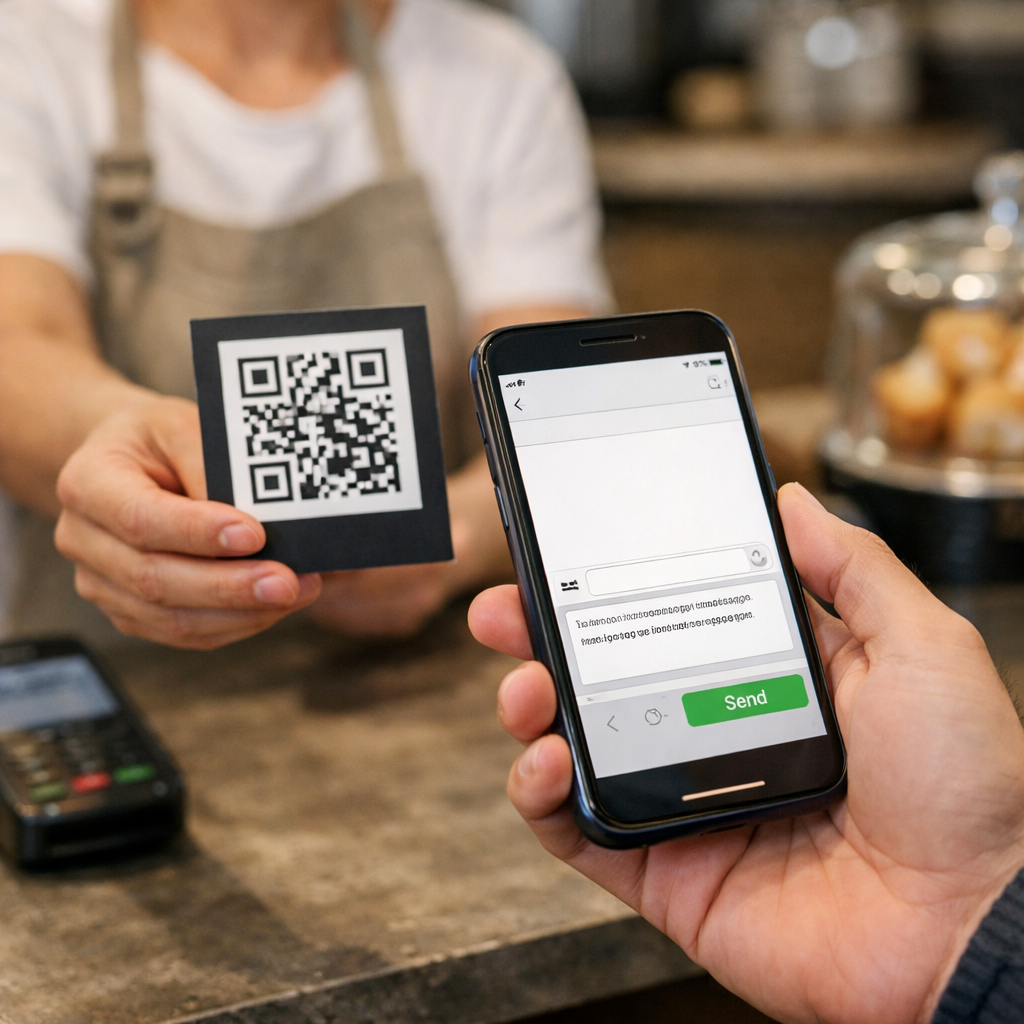
A QR code for SMS gives people a faster way to start a text conversation with your business. Instead of asking someone to remember a mobile number, type it manually, and decide what to say, the scan opens the text action immediately. In the best setups, the number is ready, the intent is clear, and the message can be started with far less friction.
That matters in the real world because most printed media loses people during the handoff. Posters, packaging, window graphics, flyers, receipts, property boards, and counter cards can all attract attention, but attention alone does not create response. For businesses in London, Greater London, and across the United Kingdom, an SMS QR workflow can make printed media more useful by turning a scan into a text enquiry, a booking request, a support prompt, or a sales conversation without forcing the user through too many steps.
💡 Short answer
A QR code for SMS helps people text your business faster by removing manual typing and reducing response friction. It is useful on printed assets because it turns offline attention into an immediate mobile action. In plain English: someone scans, their messaging app opens, and they are much closer to sending the enquiry, booking request, or support message you want.
Quick facts: how a QR code for SMS works
- Core purpose: reduce the number of steps between seeing a printed call to action and starting a text conversation.
- Best use cases: enquiries, bookings, support requests, quote requests, event RSVPs, lead capture, and printed campaign response.
- Where it works well: posters, packaging, property boards, receipts, menus, window vinyls, in-store signage, flyers, and direct mail.
- Operational upside: easier response from physical media and stronger visibility into which printed assets are worth keeping, updating, or scaling.
- Strategic fit: strongest when combined with dynamic QR workflows that let you keep control after print rather than treating each code as a one-off asset.
Complete guide: how to use a QR code for SMS to drive faster customer response
1) What a QR code for SMS actually does
A QR code for SMS is designed to trigger a text-message action on a mobile phone. When the user scans the code, the goal is simple: open the messaging flow faster than a normal printed ad or sign would allow.
That matters because ordinary print often creates avoidable friction. A leaflet says “text us now”, but the person still has to unlock the phone, open messages, type a number, think of the wording, and then decide whether it is worth the effort. Each extra step loses people.
An SMS QR code reduces that drop-off. It creates a shorter path between printed media and customer action, which is why it works well anywhere response speed matters.
2) Why this is commercially stronger than just printing a number
Plenty of businesses still print a phone number and hope that is enough. Sometimes it is, but often it is not. Response usually falls when the next step takes too much effort or too much confidence.
A QR-led SMS prompt works better because it feels immediate. The user does not have to remember anything. The path is obvious. On a busy high street, inside a venue, on packaging, or in a service environment, that difference can be the gap between interest and action.
This is also where the wider xcan.it principle of Print Now, Link Later becomes useful. Even when the printed call to action stays fixed, businesses still need operational control over what happens after print.
3) How the technical side works in practice
There are two slightly different ways people talk about this topic, and it helps to separate them clearly.
- SMS links: standards-based
sms:links can launch a messaging app with a target number. - SMS QR payloads: many QR tools also support SMS-specific payload formats that aim to open the SMS app with a number and, in many cases, a drafted message.
That distinction matters because handset and platform behaviour is not always identical. In standards material, the sms URI scheme is defined for SMS recipients, while Apple’s archived SMS link reference states that iOS supports sms:<phone> links and does not include message text in that URL format. In the commercial QR ecosystem, many tools also support payload formats intended to prefill message content. The practical lesson is simple: test the exact QR behaviour you plan to print before rollout.
4) The strongest use cases for an SMS QR code
SMS is most useful when the user wants speed more than browsing depth. That is why this format can outperform a normal URL in certain real-world situations.
- property signage: “Text for price list” or “Text to book a viewing”.
- events: “Text to RSVP” or “Text for availability”.
- retail packaging: “Text for setup help” or “Text for trade pricing”.
- service vans and vehicles: “Text for a callback”.
- hospitality: “Text for reservations” or “Text for private hire details”.
- support journeys: “Text for replacement parts” or “Text for customer service”.
These are all moments where a faster response path can matter more than a full landing page.
5) Why printed media benefits most from this approach
Printed media has one recurring problem: it catches attention in places where typing is inconvenient. People are standing, walking, travelling, waiting, shopping, or comparing options in the moment. They do not always want a long digital journey.
That is why an SMS call to action can be effective on posters, point-of-sale displays, stickers, shelf talkers, direct mail, menus, and outdoor advertising. It respects the speed of the environment. The person scans and starts the message. That is much closer to natural mobile behaviour.
If you are building larger printed deployments, the infrastructure side matters too. Guides such as Dynamic QR Code Redirect Systems Explained and QR Code Lifecycle Management are useful because they explain why post-print control matters once QR codes begin to scale.
6) The biggest mistake: treating the code as the strategy
A QR code for SMS is not the strategy. It is only the trigger.
The real strategy sits in the offer, context, and next step. If your poster says “Scan to text us” but gives no reason, response will be weak. If the printed prompt is vague, generic, or too sales-heavy, the friction comes back in a different form.
The best-performing versions usually make the outcome obvious:
- Text for today’s price
- Text to claim the offer
- Text to request a call back
- Text to book a viewing
- Text for installation help
The customer should know exactly why scanning is worth it.
7) Should the message be prefilled?
Often yes, but not always. A prefilled message reduces effort and improves consistency, especially for campaigns where you want structured responses such as “Book demo”, “Send brochure”, or “Request callback”.
However, not every workflow should lock the user into rigid wording. In higher-consideration sales or support scenarios, it can be better to open the text flow and let the customer write naturally.
A good operational split is:
- prefilled SMS for simple, repeatable calls to action
- open-ended SMS for sales, support, and service conversations that need flexibility
8) Static versus dynamic thinking
An SMS QR code can be used as a fixed, single-purpose asset, but that is usually where businesses paint themselves into a corner. Campaigns change. Numbers change. Response logic changes. Printed assets stay in circulation longer than expected.
This is why dynamic QR thinking matters operationally, even when the customer-facing action seems simple. With a managed workflow, the business can keep better control over printed assets, scan visibility, and campaign changes over time. That is the wider operational value behind Print Now, Link Later and the broader idea of operating QR codes as digital infrastructure.
9) What current reference material says
There are three useful reference angles here. First, the formal standards route: RFC 5724 defines the sms URI scheme for specifying SMS recipients. Second, Apple’s archived developer guidance on SMS Links shows that iOS supports the sms: scheme with a phone number and notes that the URL must not include message text. Third, mainstream QR tooling such as QR Code Generator’s SMS QR guide shows how commercial SMS QR formats are commonly used with a number and a prefilled text message.
That combination tells you something important: the concept is widely used, but exact device behaviour should still be tested before large print runs.
10) How London and Greater London businesses can use this well
London businesses often operate in fast, high-friction environments where speed and convenience matter more than theory. The user may be on a platform, in a queue, walking past a window, standing outside a property, or scanning packaging after a purchase.
That makes SMS QR journeys especially practical in local use cases such as:
- estate agents in Greater London: text to request viewing details from property boards.
- hospitality brands in Soho or Shoreditch: text to reserve a table or ask about private hire.
- retail kiosks in Westfield: text to check stock, delivery, or loyalty offers.
- trade suppliers in Park Royal: text for trade pricing, spec sheets, or delivery support.
- event venues across London: text for availability, ticket help, or late updates.
In each case, the printed asset becomes more than a sign. It becomes a response tool.
11) Measuring what works after print
One of the most overlooked problems in print marketing is that businesses often do not know which asset created the response. Was it the poster, the window decal, the flyer, the product insert, or the counter card?
That is why measurement matters. If the campaign is built with managed QR workflows, teams can compare scans across locations, assets, branches, and time periods. That lets them see which printed placements deserve more budget and which ones are just visual clutter.
This is where guides such as Managing QR Codes as Digital Infrastructure and The Operational Risks of Static QR Codes become commercially useful, especially for businesses running multiple physical assets at once.
12) Examples of strong SMS QR implementation
Example A — property board: the board says “Text for price list and viewing times”. The scan starts a message immediately, reducing the chance that a passer-by forgets to follow up later.
Example B — takeaway packaging: the pack says “Text us if anything is missing”. That creates a faster service route than pushing the customer through a generic website form.
Example C — event flyer: the print says “Text to reserve your place”. This works well when the response needs to happen quickly and the user is already mobile.
Example D — trade counter: the signage says “Text for technical advice”. It helps busy buyers contact the team without queueing or writing long notes.
Example E — aftercare insert: the product insert says “Text for setup support”. That reduces support friction and can improve post-purchase experience.
13) Practical checklist before rollout
Before printing an SMS QR campaign at scale, check the basics properly:
- test across devices: do not assume all phones will handle the same QR payload in the same way
- keep the call to action specific: make the benefit obvious
- match the message to the context: booking, support, quote, RSVP, or callback
- avoid overcomplicating the printed prompt: the point is speed
- check print contrast and size: poor print quality kills scan response
- plan for change after print: do not build campaigns as if nothing will ever need updating
- measure by asset or location where possible: that is how you improve future print decisions
If you want a practical route into controlled deployment, Start for Free is the cleanest xcan.it entry point for testing a small live rollout before expanding.
14) YouTube video example (one)
This video is a closer fit for the page because it focuses specifically on creating an SMS QR code rather than general QR usage. It helps support the practical “how it works” part of the guide:
15) Quote: Mark Hickman, Co-founder
“The value of a QR code for SMS is not the code itself. It is the reduction in friction. When a printed asset makes it easier for someone to respond now instead of later, response quality usually improves.”
— Mark Hickman, Co-founder, Xcan It
16) External and internal reading worth embedding
Useful external reading includes RFC 5724 on the SMS URI scheme, which is helpful for understanding the standards side of SMS links, and Apple’s SMS Links reference, which clarifies how the sms: scheme is handled on iOS. For a practical implementation angle, QR Code Generator’s SMS QR guide is useful because it shows the common commercial format used for number-plus-message SMS QR codes.
Internally, the strongest supporting reads are Print Now, Link Later for the post-print control model, Dynamic QR Code Redirect Systems Explained for the technical architecture, and QR Code Lifecycle Management for operational control as QR deployments grow.
Conclusion: a QR code for SMS works best when the response path is obvious
A QR code for SMS is useful because it helps printed media do a more immediate job. It turns physical attention into a faster mobile action and reduces the friction that usually kills response.
But the real commercial value does not come from the code alone. It comes from pairing the right call to action with the right printed context, then managing those assets properly after they are live. That is where businesses move beyond one-off QR use and start building a more controlled physical-to-digital response system.
For businesses across London, Greater London, and the UK, the opportunity is simple: make it easier for people to respond now, keep control after print, and treat every printed QR asset as something that should earn its place.
FAQs
What is a QR code for SMS?−
A QR code for SMS is a code that opens a text-message action on a mobile phone, usually with a number ready to text and, in many implementations, a drafted message to reduce typing.
How does an SMS QR code help customer response?+
It removes extra steps between seeing a printed message and starting contact, which can increase response speed and reduce drop-off.
Can I use a QR code for SMS on printed marketing?+
Yes. It works well on posters, flyers, packaging, signage, receipts, counter cards, direct mail, and property boards where quick mobile response matters.
Will every phone handle a prefilled SMS message the same way?+
No. Device and platform behaviour can vary, so the exact QR payload and scan flow should always be tested before a large print rollout.
Why does dynamic QR management matter for an SMS campaign?+
Because printed assets often outlive the original campaign logic. Dynamic workflows help teams keep control, update destinations where relevant, and measure scan activity across real-world assets.
Talk to an Xcan It Specialist
Want printed QR assets that do more than send traffic to a page? We’ll help you build smarter response journeys, stronger post-print control, and measurable scan visibility across packaging, signage, posters, and campaigns.