
The Operational Risks of Static QR Codes
Introduction
Quick Response (QR) codes are widely used to connect physical environments with digital information. They appear on product packaging, signage, posters, property listings, menus, and marketing materials, allowing users to access digital content instantly by scanning with a smartphone camera.
Many QR codes used in these contexts are static QR codes, meaning the information encoded in the code is permanently embedded in the QR pattern. Once generated and printed, the destination cannot be changed.
While static QR codes are simple to create and deploy, they introduce operational risks when used in environments where digital content may change over time. Because the physical code cannot be updated after printing, organizations may encounter problems such as broken links, outdated information, or costly reprinting requirements.
Understanding these risks is important for organizations deploying QR codes across physical environments, particularly when the printed assets remain in circulation for extended periods.
How Static QR Codes Work
A static QR code directly encodes information within the QR symbol itself. The encoded data can include:
- a URL
- plain text
- contact details
- Wi-Fi network credentials
- other small data formats
When a user scans the code, the device reads the encoded data and performs the corresponding action, such as opening a webpage.
Because the data is embedded directly into the QR pattern, it cannot be modified without generating a new code. If the encoded URL changes, the original QR code will continue directing users to the old address.
This permanent encoding is the defining characteristic of static QR codes.
Link Rot and Broken Destinations
One of the most common operational problems associated with static QR codes is link rot.
Link rot occurs when a URL referenced by a QR code becomes unavailable or invalid. This may happen when:
- a website changes its page structure
- a marketing campaign page is removed
- a domain expires or changes ownership
- a company migrates to a new website
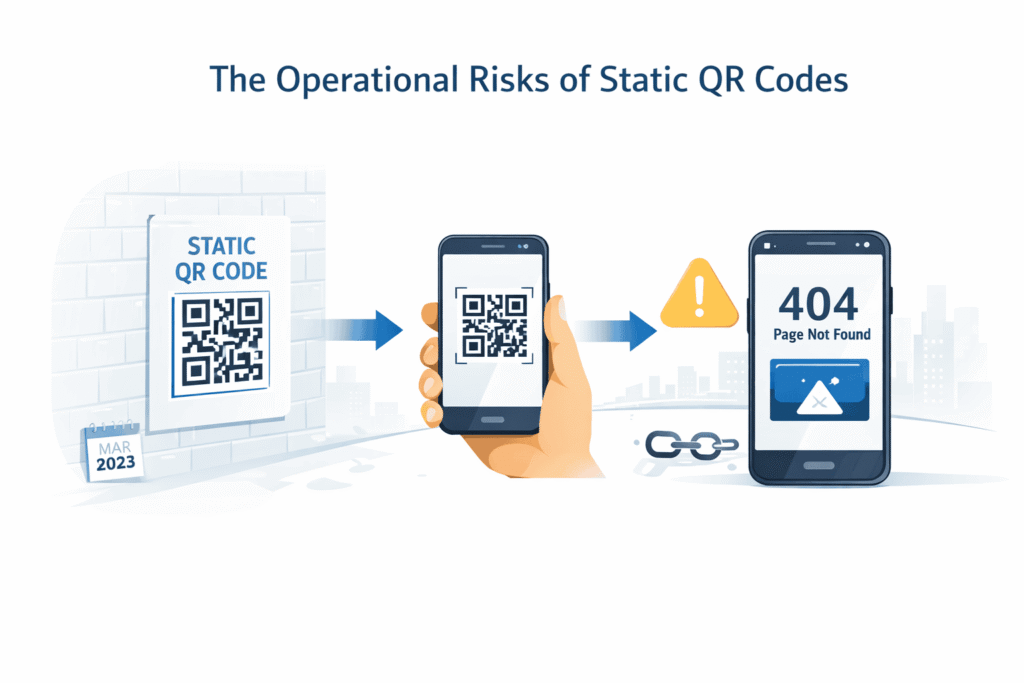
If the original URL encoded in the QR code no longer exists, users scanning the code may encounter a 404 error or an unrelated webpage.
Because the QR code cannot be updated, correcting the problem typically requires replacing the printed code on every physical asset where it appears.
For large-scale deployments, this can be costly and time-consuming.
Outdated or Irrelevant Content
Even when the encoded URL remains functional, the content associated with a static QR code may become outdated.
Examples include:
- event posters linking to expired ticket pages
- product packaging linking to outdated documentation
- restaurant menus linking to obsolete menu information
- marketing campaigns linking to promotions that have ended
In many cases, printed materials remain visible long after the campaign or event has concluded. Users scanning the code may be directed to irrelevant information, creating confusion or reducing trust in the organisation.
Because the QR code itself cannot be modified, updating the destination requires replacing the printed material.
Reprinting and Distribution Costs
Static QR codes can create operational challenges when they are printed on materials that are expensive or difficult to replace.
Examples include:
- product packaging printed in large manufacturing runs
- outdoor signage installations
- public transport information boards
- property marketing signage
- printed advertising campaigns
If the encoded destination needs to change, organizations may be forced to reprint and redistribute these materials.
For large-scale deployments, the cost of reprinting can significantly exceed the cost of generating the original QR code.
This issue becomes particularly significant when QR codes are used as long-term access points to digital information.
Loss of Analytics and Usage Data
Static QR codes typically do not provide built-in analytics.
When a user scans a static QR code, their device accesses the encoded URL directly without passing through an intermediary service. As a result, organizations often have limited visibility into how frequently their codes are scanned.
Without analytics, it can be difficult to measure:
- engagement with printed marketing materials
- usage of QR-enabled signage
- performance of physical advertising campaigns
- Organizations seeking to understand user interaction with QR codes often require additional tracking mechanisms.
Governance and Oversight Challenges
In large organisations, QR codes may be deployed by multiple teams across different departments or campaigns.
Examples include:
- marketing teams printing promotional materials
- product teams embedding QR codes in packaging
- operations teams using QR codes for equipment tracking
- property teams using QR codes for signage
Without centralised oversight, it can become difficult to track which QR codes exist, where they are deployed, and what destinations they reference.
Static QR codes make this problem more complex because their destinations cannot be modified once they have been printed.
Organisations may find that outdated or unmanaged QR codes remain in circulation long after the associated campaigns have ended.
Long-Term Persistence of Physical Assets
Physical materials often remain in the environment far longer than originally anticipated.
Examples include:
- posters remaining in public spaces after events
- printed product packaging circulating in secondary markets
- archived documents containing QR codes
- signage remaining in place for months or years
Users may continue scanning these codes long after the associated digital resources have changed.
When static QR codes are used in these contexts, the inability to update the destination creates long-term maintenance challenges.
Mitigation Strategies
Organizations deploying QR codes in physical environments can reduce operational risk by considering several mitigation strategies.
Planning for Long-Term Use
QR codes printed on durable materials should be treated as long-term digital entry points rather than temporary marketing tools.
Planning for long-term access helps ensure that the linked content remains relevant.
Maintaining Stable Destination URLs
Using stable URLs that are unlikely to change can reduce the risk of broken links. This may involve maintaining permanent landing pages that redirect to updated content.
Monitoring Deployed Codes
Organizations should maintain records of where QR codes are deployed and periodically verify that the linked content remains valid.
Monitoring helps identify outdated or broken destinations before they affect users.
Using Updateable Redirect Systems
Some deployments use redirect systems that allow QR code destinations to be modified without replacing the printed code. This approach separates the physical QR code from the final destination content, enabling updates after distribution.
Conclusion
Static QR codes provide a simple way to connect physical materials with digital content. However, because the encoded data cannot be changed after printing, they can introduce operational challenges in environments where digital resources evolve over time.
Broken links, outdated content, reprinting costs, and limited analytics are among the common risks associated with static QR deployments.
Organizations deploying QR codes across physical environments should consider how these access points will be managed throughout their lifecycle. Treating QR codes as long-term digital interfaces can help reduce operational risks and improve the reliability of physical-to-digital connections.
A static QR code contains information that is permanently encoded into the QR pattern. This data is typically a fixed URL or text. Once the code has been generated and printed, the encoded information cannot be modified without creating a new QR code.
Static QR codes cannot be updated after printing. If the destination website changes, the encoded link may become outdated or lead to a broken page. Because the code itself cannot be edited, correcting the issue usually requires replacing the printed QR code on all physical materials.
Link rot occurs when a URL referenced by a QR code no longer exists or no longer points to the intended content. This can happen when websites are redesigned, pages are removed, or domains change. Static QR codes are particularly vulnerable because the encoded destination cannot be updated.
Static QR codes typically do not provide built-in analytics. When scanned, the user’s device opens the encoded destination directly without passing through a tracking system. As a result, organizations may have limited visibility into how frequently their codes are scanned or how users interact with them.
Organizations can reduce operational risk by planning QR deployments carefully, maintaining stable destination URLs, monitoring active codes, and considering systems that allow QR destinations to be updated without replacing the printed code.