
Dynamic QR Code Redirect Systems Explained
Introduction
QR codes are widely used to connect physical environments with digital content. They appear on packaging, signage, marketing materials, and equipment labels, allowing users to access online information instantly using a smartphone camera.
While traditional QR codes encode fixed information directly within the QR symbol, dynamic QR codes use a different approach. Instead of embedding the final destination within the code itself, a dynamic QR code contains a short redirect link or identifier that points to a managed service.
This architecture allows the final destination to be updated without changing the printed QR code. As a result, dynamic QR systems enable organizations to maintain and manage QR deployments over time, even when the underlying digital content changes.
Understanding how these redirect systems work is important for organizations that rely on QR codes as long-term access points between physical and digital environments.
The Basic Architecture of Dynamic QR Codes
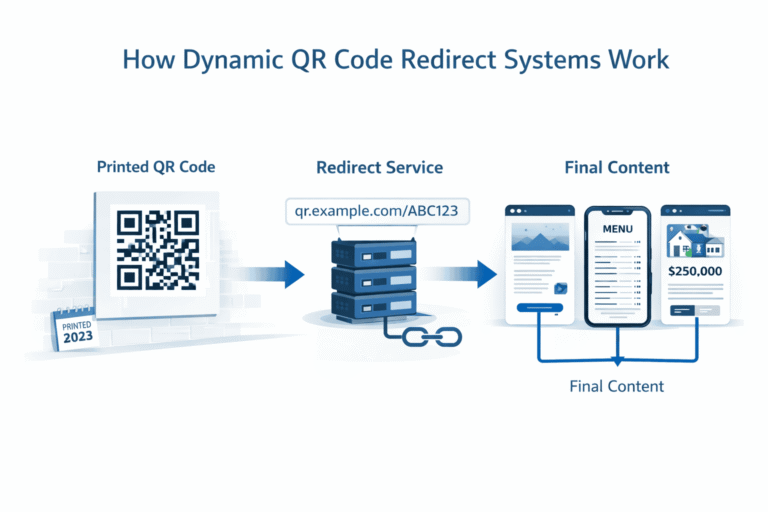
A dynamic QR code operates through a redirection layer that sits between the QR code and the final destination.
The typical process involves three components:
The printed QR code
A redirect service
The final destination content
When a user scans the code, the process unfolds in several steps.
- The smartphone reads the QR code pattern.
- The QR code resolves to a short redirect URL or identifier.
- The device contacts the redirect server.
- The redirect service determines the configured destination.
- The user is forwarded to the final webpage or digital resource.
Because the redirect service controls the final destination, the destination can be modified without changing the QR code itself.
This separation between the printed code and the destination content is the key technical feature that enables dynamic QR management.
Redirect URL Structure
Most dynamic QR codes contain a short URL or unique identifier rather than the final destination.
For example:
qr.example.com/A12345
The identifier in the URL corresponds to a record stored in the QR management system.
When the redirect server receives a request for that identifier, it retrieves the associated destination from a database and redirects the user accordingly.
This mechanism allows the destination to be modified at any time by updating the corresponding database entry.
The printed QR code remains unchanged.
Updating Destinations After Printing
One of the primary advantages of dynamic QR codes is the ability to update destinations after the code has been printed and distributed.
For example:
- a poster QR code can be redirected to a new campaign page
- a product packaging QR code can link to updated documentation
- a property sign QR code can be reassigned to a new listing
- a restaurant QR code can link to an updated menu
Instead of replacing the printed QR code, administrators update the destination within the management platform.
Because the QR code always resolves through the redirect service, the new destination is applied immediately.
This capability significantly reduces the need for reprinting physical materials.
Scan Analytics and Data Collection
Because dynamic QR scans pass through a redirect server, the scan event can be recorded before the user is forwarded to the final destination.
Typical metrics collected include:
- number of scans
- time and date of scans
- device type
- approximate geographic location based on IP address
- referral source in some cases
These insights allow organizations to measure engagement with QR-enabled physical assets.
For example, marketing teams may analyze scan activity to understand how users interact with printed advertising campaigns.
Operational teams may track usage of QR-enabled signage or product documentation.
QR Code Lifecycle Management
In large deployments, QR codes may be printed on thousands of physical assets across different locations.
Dynamic QR systems allow organizations to manage these deployments through centralized dashboards.
Typical management capabilities include:
- editing the destination of individual QR codes
- assigning descriptive identifiers to codes
- organizing codes by campaign, location, or asset type
- tracking scan activity across deployments
These capabilities allow organizations to treat QR codes as persistent digital interfaces rather than disposable marketing tools.
Managing QR codes as infrastructure helps ensure that physical assets continue to connect to relevant digital information throughout their lifecycle.
Reliability and Infrastructure Considerations
Because dynamic QR codes rely on a redirect service, the reliability of that service is critical.
If the redirect server becomes unavailable, users scanning the QR code may be unable to reach the destination content.
For this reason, dynamic QR systems are typically designed with:
- reliable hosting infrastructure
- fast redirect processing
- scalable servers capable of handling large volumes of scans
Efficient redirect systems introduce minimal delay between the scan and the final destination.
In most deployments, the redirection process occurs within milliseconds and is generally invisible to the user.
Security Considerations
Redirect-based QR systems must also consider security and governance.
Potential concerns include:
- unauthorized modification of QR destinations
- misuse of QR codes for malicious redirection
- lack of visibility into active deployments
Management platforms typically address these issues through authentication controls, administrative permissions, and activity logs.
Organizations deploying QR codes at scale may also implement governance policies to ensure that QR codes remain properly managed throughout their lifecycle.
Applications Across Industries
Dynamic QR systems are used in a wide range of industries where printed assets interact with digital information.
Examples include:
Retail and packaging
Manufacturers use QR codes to link product packaging to instructions, warranty registration, or promotional content.
Real estate and property marketing
Property signage can connect potential buyers directly to listing details and updated property information.
Transportation and public infrastructure
QR codes on signs or posters can link to updated service information or route guidance.
Hospitality and food service
Restaurants often use QR codes to provide digital menus that can be updated without reprinting physical materials.
In each case, the ability to update destinations and track engagement makes dynamic QR systems particularly useful.
Conclusion
Dynamic QR code systems separate the physical QR code from the final destination through a redirect architecture. By encoding a short identifier rather than a fixed URL, these systems allow organizations to update linked content, track usage, and manage QR deployments over time.
This architecture enables QR codes to function as long-term access points between physical environments and digital resources. As QR codes become increasingly embedded in packaging, signage, and public infrastructure, the ability to manage them dynamically becomes an important part of maintaining reliable physical-to-digital connections.
Frequently Asked Questions
A dynamic QR code redirect system uses an intermediary server between the QR code and the final destination. Instead of encoding the final webpage directly, the QR code contains a short URL or identifier that connects to a redirect service, which then forwards the user to the configured destination.
The redirect layer separates the printed QR code from the final digital content. Because the destination is stored in a database rather than encoded in the QR pattern, the linked content can be updated without replacing the printed code.
In a dynamic QR system, administrators log into a management platform and update the destination associated with the QR code’s identifier. Once the update is saved, any future scans will be redirected to the new destination automatically.
Dynamic QR scans pass through a redirect server before reaching the final content. This allows the system to record scan events such as timestamps, device type, and approximate location before forwarding the user to the destination page.
In practice, platforms manage these redirects through a dashboard where QR codes can be edited and reassigned to different destinations when needed.
Modern redirect systems operate very quickly, typically forwarding users to the final destination within milliseconds. In most cases, the redirection process is not noticeable to the person scanning the code.