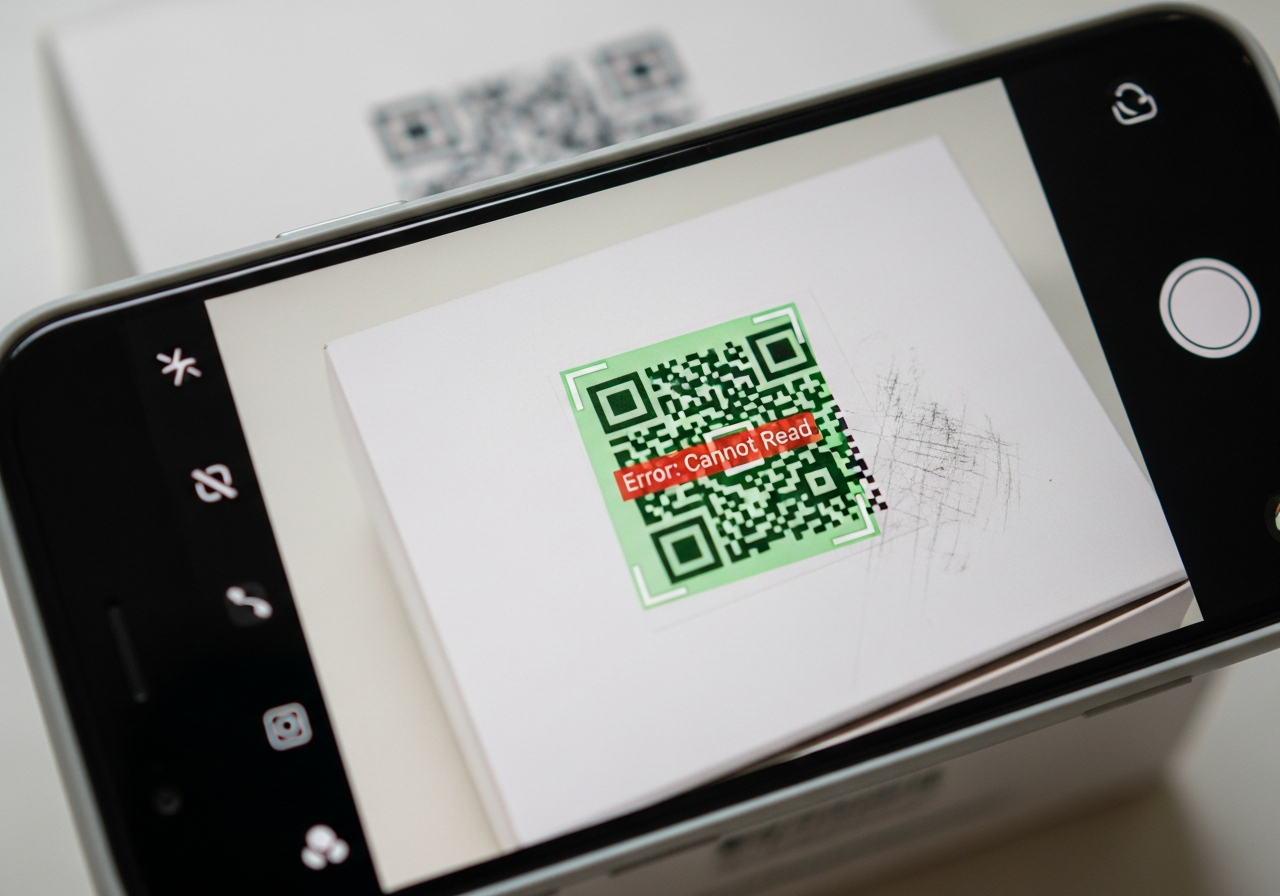

Picture this: a facilities manager walks a site and finds that nearly a third of the QR codes on equipment labels point to dead links, a figure consistent with consumer surveys showing around 29% of people have directly encountered expired or broken QR links in the wild. A contractor is working from a maintenance record that hasn’t been updated in 18 months. A health and safety notice on the wall still references a process that was decommissioned two quarters ago. Individually, each of these looks like a minor administrative slip. Together, they reveal an organisation that has lost control of the information behind its physical assets.
That loss of control is rarely dramatic. It happens gradually, one outdated link and one unmaintained record at a time, until the gap between what’s printed on an asset and what’s actually true becomes a source of contractor errors, compliance failures, and eroded trust. Regaining control follows a recognisable pattern, and this article gives you the full framework: data model, governance, tooling, security, and measurement.
The challenge of physical assets carrying outdated or unmanaged digital information has grown sharper as QR codes, asset tags, and printed signage have spread across sectors. Modern platforms now give teams the ability to update and audit that information from a single dashboard without physically touching the asset. The technology only works, though, if the governance and data model underneath it are sound.
The real cost of losing control over asset information
The gap between what’s on the asset and what’s actually true
Printed materials, equipment labels, signage, and QR codes all carry information that was accurate at the moment of production. Reality keeps moving after the print run finishes. A spec sheet gets updated, a responsible person changes role, a safety procedure is revised, and the physical asset carries on pointing to the old version. This gap is rarely caught until something goes wrong: a contractor uses outdated specifications, a member of the public follows a QR code to a 404 error page, or an auditor finds a compliance record that doesn’t match the equipment in front of them. The issue isn’t negligence. There’s simply no system keeping the physical and the digital in sync, and without one, the gap between recorded information and ground truth creates real operational and safety exposure.
Dead links and unmanaged QR codes: a liability hiding in plain sight
QR codes now appear on physical assets across retail, education, construction, government facilities, and healthcare. When those codes are static and the linked information changes, every printed asset becomes a live liability. Consumer research, including the Uniqode 2025 State of QR Codes report, consistently finds that more than half of people who scan a code leading to a dead end hesitate to trust that brand or organisation again. For a multi-site organisation managing hundreds or thousands of physical touchpoints, the operational consequences compound quickly. Staff waste time chasing the correct version of a document. Public-facing signage damages credibility. When links finally do get corrected, the reprint cost at scale is significant. Gartner has estimated that poor data quality costs organisations millions annually, and inaccurate asset records are a direct contributor.
Compliance and operational exposure when records lag behind reality
Asset information that doesn’t match ground truth creates measurable risk beyond operational inconvenience. Maintenance records, safety notices, equipment certifications, and inspection logs all depend on accurate, current data being accessible at the point of need. Industry analysts and auditors consistently cite incomplete or inaccurate fixed-asset records as a driver of inflated insurance premiums, distorted capital reporting, and regulatory exposure. Without defined processes for keeping records current, even well-intentioned teams drift into inconsistency, and the compliance gap widens every month nothing is done about it.
Building an asset data model that holds up over time
The core fields every physical asset record needs
An authoritative asset register starts with a set of non-negotiable attributes. Every record needs a unique asset ID, a descriptive name that includes make, model, and serial number, a physical location tied to a site hierarchy, an asset type or category for reporting, a responsible person or department, and a current status. These fields aren’t just for audits, they’re what allows any team member, on any shift, at any site, to find the right record, understand its context, and act on it with confidence.
For organisations with more complex requirements, financial attributes extend the model: acquisition cost, depreciation method, book value. Lifecycle data adds another layer: warranty periods, maintenance history, and condition ratings. The discipline is in deciding upfront which fields are mandatory and enforcing that consistently across sites.
Structuring a parent-child hierarchy for complex inventories
Once your asset inventory grows beyond a few dozen items, a flat list stops working. A hierarchical structure, running from facility down to equipment and then to individual components, is what makes a register scalable. This parent-child model prevents duplication and makes it possible to see both the granular detail of a single asset and aggregate views across a whole portfolio.
The practical test for any hierarchy is straightforward: can any team member find the correct record, understand what it links to, and update it without inadvertently breaking related records? If the answer isn’t clearly yes, the structure needs simplifying.
Connecting physical assets to live digital information
A data model is only as useful as the information it points to. When that information sits behind a dynamic, updateable link attached to the asset itself, rather than a static document buried in a spreadsheet, the record stays accurate without requiring a physical reprint or a label swap. This design principle is what separates a traditional asset register from a genuinely controlled information environment. The asset record tells you what the asset is and where it lives. The live link tells the person interacting with it what they need to know right now. Building both layers into your model from the start is the decision that keeps the whole system manageable as it scales.
Governance first, tools second: who owns your asset data?
Assigning clear ownership to every asset record
Asset information breaks down most often not because systems fail, but because no one was explicitly responsible for keeping a specific record current. Fixing that requires two distinct roles. A data owner is accountable for accuracy, access decisions, and compliance for a given set of records. A data steward handles the day-to-day maintenance and domain-specific updates within those records. Both roles need to be named, not assumed. Assigning ownership doesn’t mean creating bottlenecks; it means ensuring that when a record is wrong, there’s a defined person whose job it is to fix it.
Governance policies that prevent information drift
The difference between organisations that have asset data and organisations that have reliable asset data comes down to policy. Good governance covers four things:
- Validation rules at the point of data entry, to catch errors before they propagate
- Defined update triggers, what events require a record to be updated (a repair, a relocation, a change of responsible person, a document revision)
- A review cadence that brings records back into focus on a regular schedule, not just when something breaks
- Naming conventions that keep records consistent across sites, so a “Heating Unit” in Manchester isn’t stored as an “HVAC System” in Bristol
Without these, even a well-chosen platform will accumulate the same inconsistencies as the spreadsheets it replaced.
Building a cross-functional team to sustain accuracy
Asset information crosses department lines. Facilities, finance, compliance, IT, and operations all have a stake in what’s recorded and whether it’s accurate. A governance committee that brings these groups together, with a defined decision-making scope, is what prevents asset data from becoming the exclusive concern of one team while everyone else ignores it. Executive buy-in matters here not just because it unlocks budget, but because it signals to the entire organisation that data quality is an operational priority rather than a side project.
Choosing the right tools to control the information behind physical assets
What CMMS and EAM systems handle well, and where they stop
CMMS platforms are built for post-installation maintenance: work orders, preventive maintenance schedules, and repair histories. EAM systems extend this across the full asset lifecycle, from procurement through to disposal, with multi-site capability and financial integration that CMMS tools typically lack. Both are strong choices for managing internal operational records. For an in-depth comparison of how these systems differ, see CMMS vs EAM.
Where many deployments stop, however, is at the physical touchpoint. Most CMMS and EAM platforms are not designed to manage the dynamic, external-facing information that a person encounters when they interact with an asset on site. They track what happened to an asset; controlling what someone reads when they scan a label or a sign is a different problem, and one that often falls through the gap.
The physical-to-digital control layer most platforms miss
Consider a common scenario: a piece of equipment has a perfectly maintained record in the EAM system and a QR code on its label pointing to a specification document that was replaced six months ago. The internal record is accurate. The external-facing information is not. This is typically where organisations lose control over the information behind physical assets, at the interface between the asset and the person who needs information from it. The fix isn’t replacing your CMMS or EAM system. It’s adding a dedicated layer that manages the live information attached to physical assets and keeps it aligned with what teams actually want people to see.
How Xcan It gives teams centralised control in real time
Xcan It is a QR code management platform built for physical environments: signage, equipment labels, packaging, and printed materials where reprinting is costly, slow, or simply not practical. According to the platform’s documentation, when a safety notice changes, a product specification is updated, or a linked document is replaced, the destination update happens in the Xcan It dashboard and goes live instantly across every physical asset carrying that code, with no reprint and no relabelling required.
The platform is designed to give teams dynamic QR code management, real-time destination updates, engagement analytics, and role-based permissions, with the ability to manage assets across multiple sites from a single dashboard. For organisations already running a CMMS or EAM system, Xcan It sits alongside those tools, handling the physical-to-digital layer that internal maintenance platforms typically don’t cover. That combination, internal records managed in your EAM, external-facing information managed in Xcan It, is what closes the gap between what your system says and what someone actually sees on the ground.
Moving from fragmented asset records to a single source of truth
Audit your existing records before you build anything new
The most common implementation mistake is building a new system on top of unresolved data problems. Before any platform is configured, catalogue every source of asset information currently in use: spreadsheets, maintenance logs, printed registers, EAM databases, and the informal knowledge sitting in team members’ heads. Identify conflicts, duplicates, and gaps. This baseline audit determines your actual scope, tells you where the highest-risk records are, and prevents the new system from inheriting the same inconsistencies as the old one.
Cleanse, standardise, and consolidate into one authoritative record
Data cleansing isn’t a single event; it’s a process that runs domain by domain or site by site. Normalise formats across your records: location hierarchies, date conventions, naming standards. Resolve conflicting records by going back to the physical asset or the most recent verified source. Merge everything into the chosen platform in phases, so teams build confidence before it scales across the organisation.
Once the single source of truth is live, the rule is firm: other systems pull from or push to it. They don’t maintain their own independent versions of the same records.
Change management: the human side of consolidating asset data
Tools don’t keep asset information accurate; people do. Adoption depends on operational teams understanding not just that there’s a new system, but why the old approach was causing problems and how the new one fixes them. Define who updates what and when. Use access controls to prevent accidental changes while keeping the right people informed. Establish a regular review rhythm so anomalies get caught before they compound.
The governance structure built in the earlier phase is what makes this work in practice. Teams need to know who to escalate to when something looks wrong, and they need confidence that raising an issue results in a correction, not silence.
Securing asset information to meet compliance requirements
What UK GDPR and NCSC guidance require from asset information management
UK GDPR Article 5(1)(f) requires organisations to protect personal data with appropriate technical and organisational measures. For asset registers that include personal data, responsible persons, custodians, maintenance contractors, this creates direct compliance obligations alongside the operational ones. The ICO guidance on security outcomes includes a specific A.3 asset management requirement: catalogue personal data held within your systems, document processing purposes, limit data to what’s necessary, and delete records when they’re no longer needed.
NCSC’s Cyber Assessment Framework reinforces this, requiring organisations to identify and inventory all relevant physical assets, keep inventories current, assign management responsibility, and handle assets securely from creation through to disposal.
Access controls, audit trails, and role-based permissions
The practical security controls for asset information management are well-established. Authenticate and authorise users with appropriate permission levels, using two-factor authentication for anyone with privileged access. Maintain audit logs that record who changed what and when, not just for incident response, but for demonstrating compliance during audits.
For organisations managing asset information across multiple sites and departments, role-based permissions are essential: the right people update records, everyone else reads but can’t edit. This applies equally to the physical-to-digital layer. Knowing who last updated the information behind a QR code, and when, is as operationally important as knowing what the physical asset’s maintenance record contains.
Secure decommissioning and end-of-life asset records
A frequently overlooked compliance risk sits at the end of an asset’s life. Equipment that leaves a site but still has an active QR code or a live linked record creates an information leak, or at minimum, a trust problem when someone scans a code on a disposed asset and receives information that no longer applies. The decommissioning workflow needs to be as defined as the onboarding one: archive records, disable or redirect active links, update the asset register status to reflect disposal, and document the process for audit purposes. Treating decommissioning as an afterthought is how organisations end up with ghost assets and live links pointing nowhere useful.
Measuring whether your asset information is actually under control
The KPIs that reveal asset data quality problems
Four metrics surface data drift before it causes operational or compliance issues:
- Record completeness, the percentage of required fields that are actually populated across your register
- Accuracy rate, how well records align with physical spot-checks and verified sources
- Update timeliness, the average lag between a change event (a repair, a relocation, a document update) and the corresponding record update
- Link validity rate, the percentage of active digital touchpoints returning correct, current information
These align directly with the four core dimensions of data quality recognised in the field: accuracy, completeness, consistency, and timeliness. For organisations managing information behind physical assets with dynamic QR codes, scan analytics add a fifth dimension: whether people are actually reaching the intended information when they interact with an asset.
Building a monitoring cadence that sustains accuracy
Asset information management is not a project with an end date. The organisations that maintain reliable, current asset records treat monitoring as a routine, not a reaction to a visible problem. In practice, that means quarterly data audits against physical spot-checks, automated monitoring for broken links or outdated destinations, dashboard KPI reviews at governance committee level, and a defined escalation process for resolving anomalies when they surface.
The metrics from your CMMS or EAM system, MTBF, MTTR, asset availability, also depend on data quality for their accuracy. When your underlying records are reliable, every KPI calculated from them becomes more trustworthy. For practical guidance on CMMS reporting and the key KPIs to track, see CMMS reporting: key metrics and KPIs to track.
Putting it all together
Controlling the information behind physical assets is not purely a data management problem. It’s an operational, compliance, and trust issue. When the information attached to a physical asset is outdated, inaccessible, or pointing somewhere it shouldn’t, the consequences show up in contractor errors, public trust failures, compliance gaps, and reprint costs that compound at scale. The framework holds regardless of organisation size: a solid data model, clear governance with named owners, tools that cover both internal records and the external-facing information layer, security controls that meet your obligations, and metrics that surface problems early enough to act on them.
For teams managing QR codes, signage, or any physical asset that carries a link to live digital information, the gap between what a traditional CMMS or EAM system manages and what people actually encounter on the ground is real. Xcan It is built to close that gap. Update destinations, audit usage, manage permissions across departments and sites, and keep every physical asset pointing to accurate, current information, from one dashboard, in real time. That’s what genuine control over the information behind physical assets looks like in practice.
If your organisation manages printed assets, equipment labels, or public-facing signage and you’re not confident that every code and link is pointing to the right place right now, that’s the problem Xcan It was built to solve. Explore the platform and start a free trial to see how centralised QR management works across your physical estate. For a buyer-focused look at managing codes and printed materials at scale, see our QR Code Management for Print and Physical Assets: A Buyer’s Guide.