
7 QR Codes for Signage Strategies That Improve Scan Tracking
QR codes for signage work best when they do more than send people to a generic page. A good sign should create a measurable next step, whether that means product information, directions, booking, support, a customer enquiry, or a faster response route. The stronger the destination and the clearer the scan purpose, the more useful the printed sign becomes.
For businesses in London, Greater London, and across the UK, the real opportunity is not just adding a QR code to a sign. It is building signage that stays useful after print, can be updated when information changes, and gives you clearer visibility into which locations, assets, and calls to action actually produce scans.
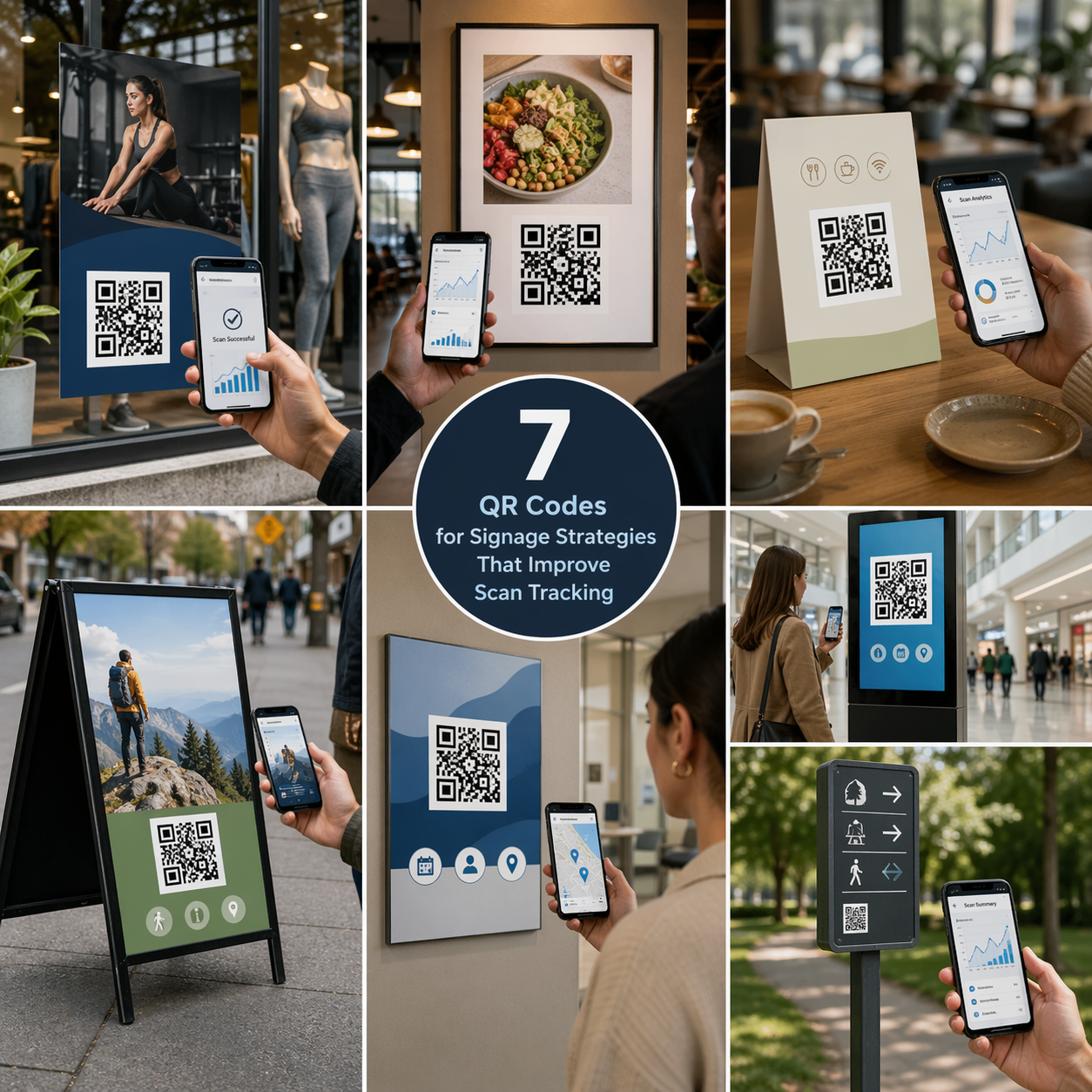
💡 Short answer
The best QR codes for signage strategies improve scan tracking by making each printed sign measurable, editable, and tied to a useful next action. That means choosing the right destination, using trackable QR codes, comparing performance by location or campaign, and keeping control after print. In practical terms, good signage QR strategy is not about the code alone. It is about what the sign leads to, what you can change later, and what scan data helps you learn next.
Quick facts: QR codes for signage
- Core advantage: QR-enabled signage turns static printed signs into measurable digital entry points.
- Best use case: signs where the linked information may change over time, such as campaigns, event details, documents, support content, menus, property details, or contact routes.
- Tracking benefit: compare scan activity by branch, sign type, call to action, date range, or location.
- Operational value: reduce unnecessary reprints when the destination changes after the sign has already been produced.
- Strategic takeaway: print once, manage always works especially well when signage needs to stay live after launch.
Complete guide: 7 QR codes for signage strategies that improve scan tracking
1) Give every sign a single, useful next action
The first mistake most businesses make is treating QR codes as decoration. A sign gets a code because it feels modern, but the person scanning lands on a generic homepage with no obvious next step. That usually weakens both conversion and scan tracking because the sign is not tied to a clear purpose.
A stronger approach is to decide what that sign is supposed to do before the code is created. Should it drive a booking? Open a product page? Launch directions? Trigger an enquiry? Start an SMS conversation? Deliver a document? Each sign should have one primary next action, because that makes performance easier to measure and the customer journey easier to understand.
For example, if the sign is intended to prompt direct contact, a QR code for email enquiries can work naturally on posters, service boards, exhibition graphics, and showroom displays where the person scanning may want to ask a question rather than browse a full website.
2) Use editable destinations so the printed sign stays useful
Signage often lasts longer than the campaign, page, phone number, or offer behind it. That is why fixed QR destinations can become expensive. The printed sign may still look right, but the linked content becomes outdated, removed, or commercially weak.
This is where dynamic QR management matters. If the destination can be edited after print, the sign keeps working even when the linked content changes. That helps operations teams, marketers, venue managers, and site teams avoid unnecessary redesign and replacement work.
It also matters financially. If you are using QR codes on boards, posters, counter cards, window graphics, hoardings, or public-facing notices, every avoidable sign replacement creates cost. That is exactly why reducing reprint costs in UK operations becomes part of the signage conversation, not just a print procurement issue.
For a direct explanation of this model, Print Now, Link Later is the clearest supporting read.
3) Track signs by location, asset type, and campaign purpose
Scan tracking becomes more useful when it answers a specific business question. Which branch gets the most scans? Which event panel performs better? Which poster call to action creates more response? Which property board creates more enquiries? Which wayfinding sign is actually used?
If all signage points into one undifferentiated destination, the data is too vague to act on. A better strategy is to structure the signage rollout so scan data can be compared by location, asset, or campaign objective. That makes the physical estate easier to manage and helps you improve weak signs instead of guessing.
In practice, this could mean separate QR instances for each branch, separate routes for window signage versus in-store signage, or distinct destinations for campaign boards, support panels, and enquiry-led assets.
4) Match the destination type to the context of the sign
Not every sign should link to a website page. Sometimes a lighter action works better because it matches the scanning moment.
- Window signage: directions, booking, product shortlist, or out-of-hours browse route
- Exhibition signage: brochure, meeting request, demo page, or follow-up enquiry
- Service-area signage: support information, booking amendment, or issue reporting
- Promotional signage: campaign page, offer explanation, or product launch content
- Fast-response signage: a QR code for SMS response can be useful where speed matters more than browsing depth
This matters because a signage scan is usually a short-attention moment. The person is standing, moving, waiting, or passing by. If the destination asks too much too soon, response drops. Good signage strategy reduces friction at the exact moment of intent.
5) Design the sign so the QR code supports the message, not the other way round
A QR code should not overpower the sign. The sign still needs a clear headline, context, and reason to scan. People do not scan because a code exists. They scan because the sign gives them a reason.
That usually means the sign should answer three things quickly:
- what this is
- why I should scan it
- what happens next
For higher-performance signage, add a short benefit-led call to action such as “Scan for live availability”, “Scan for directions”, “Scan for the full specification”, or “Scan to contact the team”. This makes the code part of the sign’s commercial job rather than a detached technical element.
6) Test where signage scans actually happen
Many signage QR failures are not strategic. They are practical. The sign is too high. The lighting is poor. The finish reflects glare. The code is too small. The viewer is moving too quickly. The mobile signal is weak. The placement competes with too much other information.
That is why real-world testing matters before a wider rollout. A QR strategy that looks fine on a mock-up can underperform in a corridor, reception area, roadside environment, event hall, station approach, or shop window.
Testing should cover:
- viewing distance
- scan speed
- light reflection and finish
- network conditions
- clarity of the call to action
- whether the landing experience matches the sign promise
When signage is expected to stay in place for months, a small amount of testing upfront can protect a much larger print and installation cost later.
7) Use scan data to improve future signage, not just report on the past
The strongest QR codes for signage strategies do not stop at measurement. They use measurement to improve the next version of the sign estate. If one sign format works better than another, that should influence future design. If one location produces weak scan response, that should trigger a placement review. If one type of destination performs better, that should shape future call to action choices.
That is the real benefit of scan tracking: it helps signage move from static print output to a manageable operating asset. The sign is no longer just something installed and forgotten. It becomes something you can compare, improve, and keep commercially useful over time.
Why this matters more for UK signage programmes
In the UK, signage programmes often span multiple locations, departments, suppliers, and update cycles. A retail estate may have windows, shelf signage, and campaign boards. A local authority may have notices, service signs, and consultation signage. A venue may use event boards, directional signs, and sponsor displays. A property business may rely on boards, posters, and temporary promotional assets.
Across all of these, the common challenge is the same: printed signs stay in the world longer than the information behind them. That is why QR-led signage works best when the organisation keeps post-print control rather than treating signage as a one-off production job.
Examples section: where the strategy works in practice
Example A — retail window signage: a London retailer places QR codes on window graphics so passers-by can browse featured products after closing time. Each store uses its own code instance, making it easier to compare scan activity by branch.
Example B — exhibition stand panels: a B2B team uses signage QR codes on stand graphics that route visitors to product sheets, demo booking, and direct contact options. The scans show which product theme attracted the strongest interest during the event.
Example C — service and facilities signage: a multi-site operator uses QR signage on information boards so users can report an issue, request help, or access updated guidance without the board needing to be replaced every time details change.
Example D — property and development signage: boards route viewers to live listings, brochure downloads, and contact actions. Separate QR instances allow the marketing team to compare which sites attract the strongest scan response.
Example E — public-facing notices: temporary notices and permanent signs link to current information that may change after installation. Instead of replacing the sign each time, the organisation updates the destination behind it.
YouTube video example (one)
This video is a stronger fit for the page because it focuses on dynamic QR codes on signage and explains the post-print update angle clearly, which is central to the strategy discussed throughout this guide:
Quote: Mark Hickman, Co-founder
“The real value in QR codes for signage is not that the sign can be scanned. It is that the sign can stay live, stay measurable, and stay useful after it has already been printed and installed.”
— Mark Hickman, Co-founder, Xcan It
External and internal reading worth embedding
Useful external reading includes Shopify’s guidance on using QR codes on retail displays, which is helpful for signage that needs to keep working outside opening hours, and Shopify’s retail signage guide, which adds broader placement and signage design context.
For implementation and standards thinking, GS1 UK’s implementation best practice guide and GS1 UK’s QR code design guidelines are both useful reads if your signage programme overlaps with packaging, product data, or wider 2D code planning.
Internally, the strongest supporting reads are 12 ways to reduce reprint costs in your UK business, how to use a QR code for email to drive more customer enquiries, how to use a QR code for SMS to drive faster customer response, and Print Now, Link Later for the broader print-once, manage-always operating model.
Practical checklist before rollout
- define the purpose of each sign: enquiry, information, booking, support, product detail, directions, or promotion
- choose editable destinations: avoid locking long-life signs to short-life pages
- set up meaningful tracking: compare scans by sign, branch, campaign, or location
- keep the call to action specific: tell people exactly why they should scan
- test real-world scan conditions: height, lighting, movement, finish, and signal all matter
- match the destination to the moment: faster actions usually work better on the move
- review scan data regularly: use it to improve signage rather than just report it
Conclusion: signage works harder when it stays measurable after print
QR codes for signage are most valuable when they help a printed asset keep doing useful work after production. That means the sign should lead to the right next action, support meaningful scan tracking, and stay manageable when information changes later.
For businesses across London and the UK, that turns signage from a static printed object into a live operational asset. Instead of replacing signs every time a destination changes, teams can keep control after print, compare performance across locations, and improve the physical-to-digital journey over time.
The strongest result is simple: print once, manage always, and make every sign easier to measure.
FAQs
How do QR codes for signage improve scan tracking?−
They turn printed signs into measurable touchpoints. You can compare scans by location, sign type, campaign, or date range and learn which assets are actually being used.
What should a signage QR code link to?+
It should link to the most useful next step for that context, such as booking, directions, support content, product information, a downloadable brochure, an enquiry route, or a fast-response contact option.
Why are editable destinations important?+
Because signs often remain in place longer than the content behind them. Editable destinations let you update the link later without replacing the printed sign.
Can QR codes work on permanent and temporary signage?+
Yes. They are useful on both long-life signage and short-run campaign materials, especially where the destination may change or scan measurement matters.
What makes a signage QR code perform better?+
A clear call to action, the right destination for the context, good placement, scannable sizing, low-friction landing experience, and a tracking setup that lets you compare results properly.
Talk to an Xcan It Specialist
Need QR codes for signage that stay editable, measurable, and easier to manage after print? We’ll help you build signage workflows that support scan tracking, reduce reprints, and keep printed assets useful across London, Greater London, and UK-wide operations.