
US House Committee Advances Bill to Replace Brake Tags with QR Codes
A landmark legislative move is pushing QR codes into government vehicle inspection infrastructure — and it changes everything about how physical documents scale digitally.
What's Happening — and Why It Matters
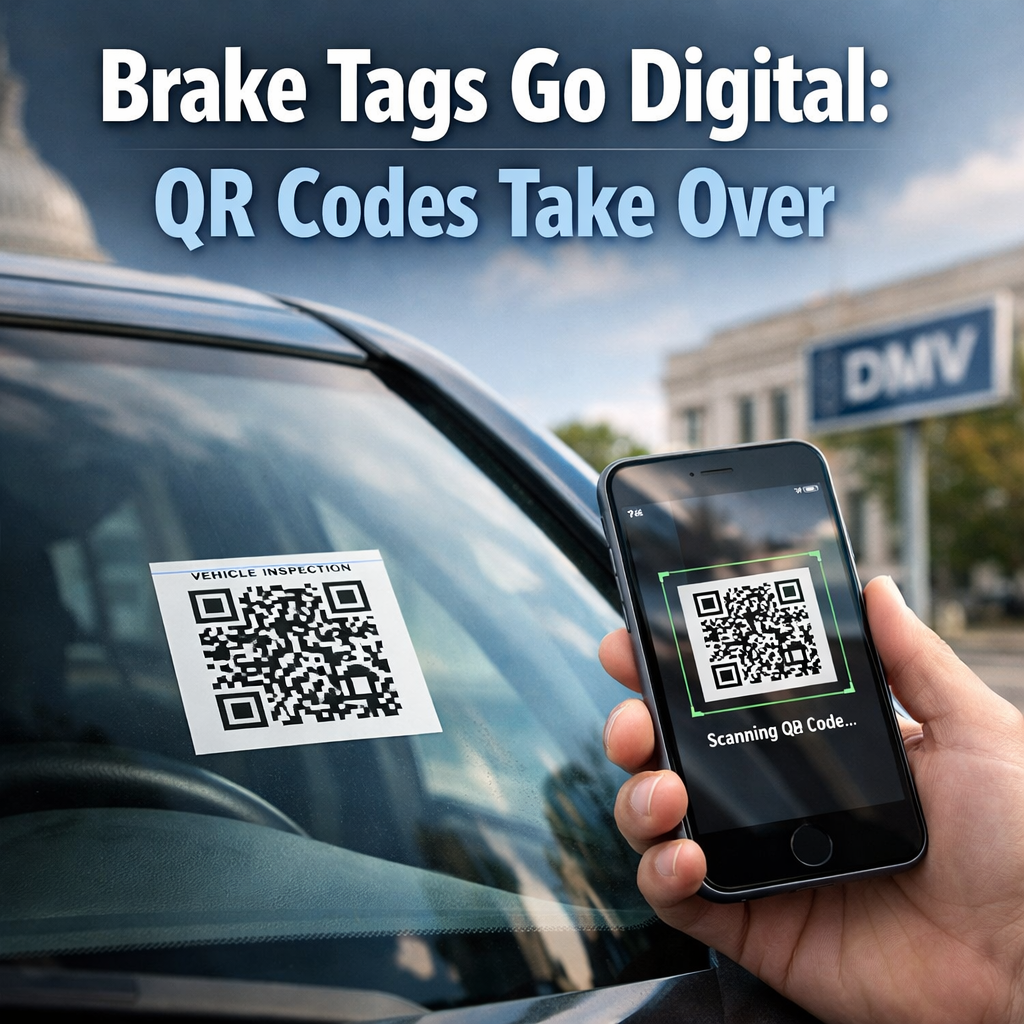
A US House committee has advanced legislation that would replace traditional paper brake tags — the physical inspection stickers affixed to vehicle windscreens — with dynamic QR codes. The move signals a structural shift in how governments are beginning to treat physical documentation: not as a fixed artefact, but as a live digital reference point.
For the QR code industry, this is not a novelty story. It is validation at the highest institutional level that dynamic QR codes are mature enough to underpin regulatory and compliance infrastructure. If government is ready to trust them on every vehicle on the road, the private sector has no excuse for still using static codes on printed marketing materials.
Here is what the bill entails, why it represents a broader inflection point, and how platforms like Xcan.it are already purpose-built for exactly this kind of long-lived, print-once infrastructure use case.
Update destination URL without reprinting the physical code
Government-grade use case: vehicle compliance & inspection records
Instant scan access to real-time vehicle inspection data
Eliminates annual sticker reprints — one code, managed digitally
Tamper-evident and verifiable by enforcement officers instantly
Scan analytics enable compliance tracking at scale
What Is a Brake Tag — and What's Wrong With It?
In several US states, particularly Louisiana, a "brake tag" is a mandatory vehicle inspection sticker issued annually after a car passes a safety check. It is displayed on the windscreen and inspected by law enforcement to confirm the vehicle has passed its required assessment.
The problem is structural: it is a paper document in a digital world. It can be forged. It carries no live data. It tells an officer nothing beyond a date. And every year, millions of them are reprinted, issued, and stuck to glass — at public cost, for a one-way information transfer that ends the moment the sticker is printed.
The Bill: What the House Committee Has Advanced
The House committee's move to advance this legislation marks a significant step in modernising vehicle inspection infrastructure across participating US states. Rather than issuing a physical sticker after a successful brake and safety inspection, the proposal would issue a QR code — scannable by law enforcement, DMV systems, and vehicle owners alike — that links to a verified, live inspection record.
Key Elements of the Proposal
- QR codes replace windscreen stickers as the primary vehicle inspection identifier
- Codes link to live government databases — inspection status is real-time, not frozen at point of print
- Law enforcement can scan codes at roadside to verify current compliance instantly
- Forgery risk is significantly reduced — a fake sticker can pass a visual check; a fake QR code cannot pass a database query
- Annual reprint cost eliminated — the code persists; only the destination data is updated
Why QR Codes Are the Right Solution Here
The brake tag use case is not merely convenient — it is the definitive argument for dynamic QR codes over static physical documentation. Let us be precise about why.
1. The Code Is Permanent; the Data Is Not
This is the fundamental insight the bill is built on: the printed QR code does not need to change when the underlying information changes. A vehicle that gets re-inspected six months later does not require a new sticker — the QR code simply points to updated records. This is the "print now, link later" model operating at government scale.
2. Verification Is Active, Not Passive
A paper sticker is verified visually — which means it is verified superficially. A QR code scan triggers a live database query. The difference between "this sticker looks right" and "this record confirms compliance as of today" is the difference between a paper system and a digital infrastructure system.
3. Scalability Without Reprint Cost
Millions of brake tags are issued annually across affected states. Replacing that print-and-reissue cycle with a managed QR infrastructure represents significant cost reduction — and that cost argument is precisely why budget-conscious governments find the proposition compelling.
4. It Mirrors What Forward-Thinking Businesses Already Do
Restaurants, property developers, transit authorities, and event venues have been managing printed QR codes with dynamic back-ends for years. The government is not inventing something new — it is adopting what the private sector proved out at scale.
Print Now, Link Later: The Infrastructure Model That Makes This Work
The brake tag bill works because of a principle that Xcan.it was built around from day one: print now, link later.
The concept is straightforward but the operational implications are profound. You generate a QR code. You print it — on a sticker, a poster, a sign, a product label, a government document. The physical item goes out into the world. Later — days, months, or years after print — you update where the code points. The printed artefact never changes. The experience it delivers does.
For government vehicle inspection, this means: issue the QR code at point of inspection, update the linked record at each re-inspection. The physical code on the windscreen is the constant; the compliance data it surfaces is always current.
For businesses, the same logic applies across every use case where print and digital need to remain in sync:
- Marketing campaigns: Print a run of 50,000 leaflets. Redirect to a new landing page mid-campaign without reprinting.
- Restaurant menus: Seasonal menu changes update behind the code — no new printed menus required.
- Road signage: Update diversion routes or event information without replacing physical signs.
- Fire safety compliance: Inspection records on fire doors stay current without reprinting certificates.
Watch: House Committee Advances the QR Brake Tag Bill
The news report below covers the House committee's decision in detail, including the legislative rationale and the response from state transportation authorities.
"When governments start replacing legal compliance documents with dynamic QR codes, it is not a technology story — it is an infrastructure story. The brake tag bill is proof that the 'print now, link later' model has reached institutional maturity. At Xcan.it, we built this infrastructure for businesses years ago. The principle is identical: one code, permanent on the physical surface, infinitely updatable behind it. That is what future-proof looks like."
Xcan.it Verdict
What the brake tag bill signals for QR code infrastructure — and what to do about it now
The brake tag legislation is the clearest signal yet that dynamic QR codes are no longer a marketing tool — they are digital infrastructure. If your organisation is still using static QR codes or hasn’t moved to a managed platform, the gap between you and best practice is now measurable in government policy.
Frequently Asked Questions
Ready to Build Your Own Dynamic QR Infrastructure?
Start with 10 free dynamic QR codes — no credit card, no time limit. Generate, print, and update your codes from one UK-built platform. When government trusts QR codes for vehicle compliance, your business can certainly trust them for marketing, signage, and operations.
Get 10 Free Dynamic QR Codes →Free forever plan · No credit card required · UK-built platform · View all plans